Culvert Authoring
Python #!pip install --upgrade ras-commander
Development Mode
Set USE_LOCAL_SOURCE = True when running from a local ras-commander checkout. The committed default uses the installed package; repository test execution can still use local source through PYTHONPATH.
Culvert Geometry Authoring
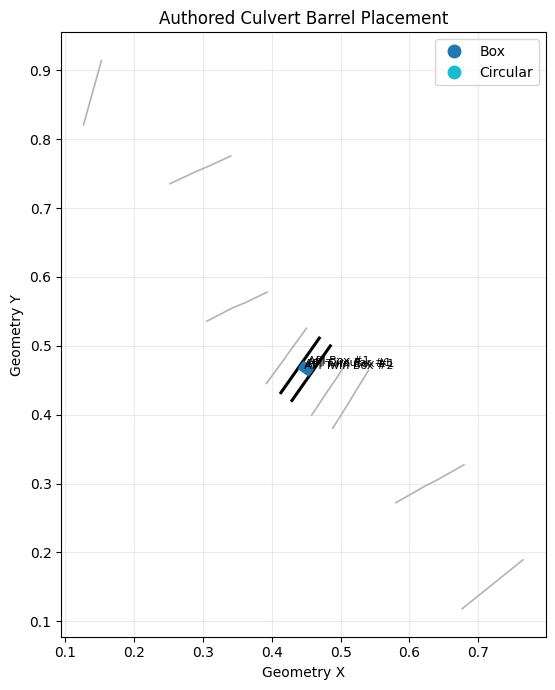
Author culvert records in a real HEC-RAS geometry file, coordinate adjacent ineffective-flow areas, visualize the authored layout, and compute the plan to validate the edited geometry.
Python # =============================================================================
# DEVELOPMENT MODE TOGGLE
# =============================================================================
USE_LOCAL_SOURCE = False
if USE_LOCAL_SOURCE :
import sys
from pathlib import Path
cwd = Path . cwd ()
local_path = cwd if ( cwd / "ras_commander" ) . exists () else cwd . parent
if str ( local_path ) not in sys . path :
sys . path . insert ( 0 , str ( local_path ))
print ( f "LOCAL SOURCE MODE: loading from { local_path / 'ras_commander' } " )
else :
print ( "PIP PACKAGE MODE: loading installed ras-commander" )
from pathlib import Path
import logging
import os
import time
import warnings
import geopandas as gpd
import matplotlib.pyplot as plt
import numpy as np
import pandas as pd
from IPython.display import display
from shapely.geometry import LineString
from ras_commander import HdfResultsPlan , RasCmdr , RasExamples , RasPrj , init_ras_project
from ras_commander.geom import GeomCrossSection , GeomCulvert
warnings . filterwarnings ( "ignore" , category = FutureWarning )
logging . getLogger ( "ras_commander" ) . setLevel ( logging . CRITICAL )
pd . set_option ( "display.max_columns" , None )
pd . set_option ( "display.max_colwidth" , 120 )
import ras_commander
print ( f "Loaded: { ras_commander . __file__ } " )
Text Only PIP PACKAGE MODE: loading installed ras-commander
Loaded: C:\GH\symphony-workspaces\ras-commander\CLB-305\ras_commander\__init__.py
Parameters
The workflow starts from the official HEC-RAS Example 4 - Multiple Culverts project because it already contains a runnable steady-flow culvert structure with plan-view cut lines.
Python PROJECT_NAME = "Example 4 - Multiple Culverts"
PROJECT_SUFFIX = "209_culvert_authoring"
PLAN_NUMBER = "01"
NUM_CORES = 1
RAS_EXE = Path ( os . environ . get (
"HECRAS_EXE" ,
r "C:/Program Files (x86)/HEC/HEC-RAS/7.0/Ras.exe" ,
))
cwd = Path . cwd ()
REPO_ROOT = cwd if ( cwd / "ras_commander" ) . exists () else cwd . parent
WORK_ROOT = Path ( os . environ . get (
"RAS_COMMANDER_WORKDIR" ,
REPO_ROOT / "working" / "culvert_authoring" ,
))
if not RAS_EXE . exists ():
raise FileNotFoundError ( f "HEC-RAS executable not found: { RAS_EXE } " )
WORK_ROOT . mkdir ( parents = True , exist_ok = True )
print ( f "HEC-RAS executable: { RAS_EXE } " )
print ( f "Working folder: { WORK_ROOT } " )
Text Only HEC-RAS executable: C:\Program Files (x86)\HEC\HEC-RAS\7.0\Ras.exe
Working folder: C:\GH\symphony-workspaces\ras-commander\CLB-305\working\culvert_authoring
Extract And Inspect The Project
Python project_path = RasExamples . extract_project (
PROJECT_NAME ,
output_path = WORK_ROOT ,
suffix = PROJECT_SUFFIX ,
)
ras_obj = RasPrj ()
init_ras_project (
project_path ,
str ( RAS_EXE ),
ras_object = ras_obj ,
load_results_summary = False ,
)
plan_rows = ras_obj . plan_df [
ras_obj . plan_df [ "plan_number" ] . astype ( str ) . str . zfill ( 2 ) . eq ( PLAN_NUMBER )
]
if plan_rows . empty :
raise ValueError ( f "Plan { PLAN_NUMBER } not found" )
plan_row = plan_rows . iloc [ 0 ]
geom_file = Path ( plan_row [ "Geom Path" ])
plan_path = Path ( plan_row [ "full_path" ])
print ( f "Project path: { project_path } " )
print ( f "Geometry file: { geom_file . name } " )
display ( ras_obj . plan_df [[ "plan_number" , "Plan Title" , "Geom File" , "Flow File" , "flow_type" ]])
baseline_culverts = GeomCulvert . get_all ( geom_file )
if baseline_culverts . empty :
raise ValueError ( "No culvert structure found in the selected geometry" )
display_cols = [
"River" , "Reach" , "RS" , "CulvertName" , "RecordType" , "ShapeName" ,
"Span" , "Rise" , "Length" , "NumBarrels" , "BarrelStations" ,
]
display ( baseline_culverts [ display_cols ])
structure = baseline_culverts . iloc [ 0 ]
river = structure [ "River" ]
reach = structure [ "Reach" ]
rs = str ( structure [ "RS" ])
print ( f "Authoring target: { river } / { reach } / RS { rs } " )
Text Only Project path: C:\GH\symphony-workspaces\ras-commander\CLB-305\working\culvert_authoring\Example 4 - Multiple Culverts_209_culvert_authoring
Geometry file: MULTCULV.g01
plan_number
Plan Title
Geom File
Flow File
flow_type
0
01
Spring Creek Multiple Culverts
01
01
Steady
River
Reach
RS
CulvertName
RecordType
ShapeName
Span
Rise
Length
NumBarrels
BarrelStations
0
Spring Creek
Culvrt Reach
20.237
Box
Multiple Barrel Culv
Box
3.0
5.0
50.0
2
[(988.5, 988.5), (1011.5, 1011.5)]
1
Spring Creek
Culvrt Reach
20.237
Circular
Multiple Barrel Culv
Circular
6.0
NaN
50.0
2
[(996.0, 996.0), (1004.0, 1004.0)]
Text Only Authoring target: Spring Creek / Culvrt Reach / RS 20.237
Author Culvert Records
set_culverts() replaces the culvert records at the existing bridge/culvert structure. The authored set covers a circular single-barrel record, a box single-barrel record, and a box multi-barrel record.
Python authored_culverts = [
{
"ShapeName" : "Circular" ,
"Span" : 4.0 ,
"Length" : 50.0 ,
"ManningsN" : 0.013 ,
"EntranceLoss" : 0.5 ,
"ExitLoss" : 1.0 ,
"InletType" : 1 ,
"OutletType" : 1 ,
"UpstreamInvert" : 25.1 ,
"UpstreamStation" : 996.0 ,
"DownstreamInvert" : 25.0 ,
"DownstreamStation" : 996.0 ,
"CulvertName" : "API Circular" ,
"BottomN" : 0.013 ,
"ChartNumber" : 5 ,
},
{
"ShapeName" : "Box" ,
"Span" : 3.0 ,
"Rise" : 5.0 ,
"Length" : 50.0 ,
"ManningsN" : 0.013 ,
"EntranceLoss" : 0.2 ,
"ExitLoss" : 1.0 ,
"InletType" : 10 ,
"OutletType" : 2 ,
"UpstreamInvert" : 28.1 ,
"UpstreamStation" : 988.5 ,
"DownstreamInvert" : 28.0 ,
"DownstreamStation" : 988.5 ,
"CulvertName" : "API Box" ,
"BottomN" : 0.013 ,
"ChartNumber" : 5 ,
},
{
"ShapeName" : "Box" ,
"Span" : 3.0 ,
"Rise" : 5.0 ,
"Length" : 50.0 ,
"ManningsN" : 0.014 ,
"EntranceLoss" : 0.2 ,
"ExitLoss" : 1.0 ,
"InletType" : 10 ,
"OutletType" : 2 ,
"UpstreamInvert" : 28.1 ,
"DownstreamInvert" : 28.0 ,
"NumBarrels" : 2 ,
"BarrelStations" : [( 1004.0 , 1004.0 ), ( 1011.5 , 1011.5 )],
"CulvertName" : "API Twin Box" ,
"BottomN" : 0.014 ,
"ChartNumber" : 5 ,
},
]
write_result = GeomCulvert . set_culverts (
geom_file ,
river ,
reach ,
rs ,
authored_culverts ,
)
print ( write_result )
round_trip_culverts = GeomCulvert . get_culverts ( geom_file , river , reach , rs )
round_trip_cols = [
"CulvertName" , "RecordType" , "ShapeName" , "Span" , "Rise" , "Length" ,
"ManningsN" , "EntranceLoss" , "ExitLoss" , "InletType" , "OutletType" ,
"UpstreamInvert" , "DownstreamInvert" , "NumBarrels" , "BarrelStations" ,
"BottomN" , "ChartNumber" ,
]
display ( round_trip_culverts [ round_trip_cols ])
assert round_trip_culverts [ "CulvertName" ] . tolist () == [
"API Circular" , "API Box" , "API Twin Box"
]
assert round_trip_culverts [ "ShapeName" ] . tolist () == [ "Circular" , "Box" , "Box" ]
assert round_trip_culverts [ "RecordType" ] . tolist () == [
"Culvert" , "Culvert" , "Multiple Barrel Culv"
]
assert round_trip_culverts . loc [ 2 , "NumBarrels" ] == 2
assert round_trip_culverts . loc [ 2 , "BarrelStations" ] == [
( 1004.0 , 1004.0 ), ( 1011.5 , 1011.5 )
]
print ( "Round-trip validation passed." )
Text Only {'culverts_written': 3, 'lines_replaced': 6, 'lines_inserted': 7, 'backup_path': 'C:\\GH\\symphony-workspaces\\ras-commander\\CLB-305\\working\\culvert_authoring\\Example 4 - Multiple Culverts_209_culvert_authoring\\MULTCULV.g01.bak'}
CulvertName
RecordType
ShapeName
Span
Rise
Length
ManningsN
EntranceLoss
ExitLoss
InletType
OutletType
UpstreamInvert
DownstreamInvert
NumBarrels
BarrelStations
BottomN
ChartNumber
0
API Circular
Culvert
Circular
4.0
NaN
50.0
0.013
0.5
1.0
1
1
25.1
25.0
1
[(996.0, 996.0)]
0.013
5
1
API Box
Culvert
Box
3.0
5.0
50.0
0.013
0.2
1.0
10
2
28.1
28.0
1
[(988.5, 988.5)]
0.013
5
2
API Twin Box
Multiple Barrel Culv
Box
3.0
5.0
50.0
0.014
0.2
1.0
10
2
28.1
28.0
2
[(1004.0, 1004.0), (1011.5, 1011.5)]
0.014
5
Text Only Round-trip validation passed.
Coordinate Adjacent Ineffective-Flow Areas
The culvert helper locates the bounding cross sections, then delegates the cross-section edits to GeomCrossSection.set_ineffective_flow().
Python adjacent = GeomCulvert . get_adjacent_cross_sections ( geom_file , river , reach , rs )
print ( adjacent )
upstream_ineffective = [
{ "left_station" : 856.0 , "right_station" : 984.0 , "elevation" : 31.0 },
{ "left_station" : 1018.0 , "right_station" : 1150.0 , "elevation" : 31.0 },
]
downstream_ineffective = [
{ "left_station" : 856.0 , "right_station" : 984.0 , "elevation" : 31.0 },
{ "left_station" : 1018.0 , "right_station" : 1150.0 , "elevation" : 31.0 },
]
ineffective_result = GeomCulvert . set_adjacent_ineffective_flow (
geom_file ,
river ,
reach ,
rs ,
upstream_ineffective = upstream_ineffective ,
downstream_ineffective = downstream_ineffective ,
)
print ( ineffective_result )
ineffective_rows = []
for side in [ "upstream" , "downstream" ]:
xs_rs = ineffective_result [ f " { side } _rs" ]
ineff_df , _ , flags = GeomCrossSection . get_ineffective_flow (
geom_file ,
river ,
reach ,
xs_rs ,
)
side_df = ineff_df . copy ()
side_df . insert ( 0 , "Side" , side )
side_df . insert ( 1 , "XS RS" , xs_rs )
side_df [ "Permanent" ] = flags
ineffective_rows . append ( side_df )
ineffective_summary = pd . concat ( ineffective_rows , ignore_index = True )
display ( ineffective_summary )
Text Only {'upstream': {'River': 'Spring Creek', 'Reach': 'Culvrt Reach', 'RS': '20.238', 'Type': 1, 'LineIndex': 89}, 'downstream': {'River': 'Spring Creek', 'Reach': 'Culvrt Reach', 'RS': '20.227', 'Type': 1, 'LineIndex': 137}}
{'upstream_rs': '20.238', 'downstream_rs': '20.227', 'updated': ['upstream', 'downstream']}
Side
XS RS
left_station
right_station
elevation
Permanent
0
upstream
20.238
856.0
984.0
31.0
False
1
upstream
20.238
1018.0
1150.0
31.0
False
2
downstream
20.227
856.0
984.0
31.0
False
3
downstream
20.227
1018.0
1150.0
31.0
False
Plan View Placement
Python def interpolate_xs_point ( xyz_df , xs_rs , station ):
group = xyz_df [ xyz_df [ "RS" ] . astype ( str ) . eq ( str ( xs_rs ))] . sort_values ( "station" )
if group . empty :
raise ValueError ( f "No coordinates found for cross section { xs_rs } " )
x = np . interp ( station , group [ "station" ], group [ "x" ])
y = np . interp ( station , group [ "station" ], group [ "y" ])
z = np . interp ( station , group [ "station" ], group [ "z" ])
return x , y , z
xs_xyz = GeomCrossSection . get_xs_coords ( geom_file , river = river , reach = reach )
xs_line_rows = []
for ( group_river , group_reach , xs_rs ), group in xs_xyz . groupby ([ "river" , "reach" , "RS" ]):
ordered = group . sort_values ( "station" )
xs_line_rows . append ({
"River" : group_river ,
"Reach" : group_reach ,
"RS" : xs_rs ,
"RSNum" : float ( str ( xs_rs ) . replace ( "*" , "" )),
"geometry" : LineString ( zip ( ordered [ "x" ], ordered [ "y" ])),
})
xs_gdf = gpd . GeoDataFrame ( xs_line_rows , geometry = "geometry" )
upstream_rs = adjacent [ "upstream" ][ "RS" ]
downstream_rs = adjacent [ "downstream" ][ "RS" ]
barrel_rows = []
for _ , culvert in round_trip_culverts . iterrows ():
for barrel_index , ( up_station , down_station ) in enumerate ( culvert [ "BarrelStations" ], start = 1 ):
up_x , up_y , up_z = interpolate_xs_point ( xs_xyz , upstream_rs , up_station )
down_x , down_y , down_z = interpolate_xs_point ( xs_xyz , downstream_rs , down_station )
barrel_rows . append ({
"CulvertName" : culvert [ "CulvertName" ],
"ShapeName" : culvert [ "ShapeName" ],
"Barrel" : barrel_index ,
"UpstreamStation" : up_station ,
"DownstreamStation" : down_station ,
"UpstreamInvert" : culvert [ "UpstreamInvert" ],
"DownstreamInvert" : culvert [ "DownstreamInvert" ],
"UpstreamGround" : up_z ,
"DownstreamGround" : down_z ,
"geometry" : LineString ([( up_x , up_y ), ( down_x , down_y )]),
})
barrel_gdf = gpd . GeoDataFrame ( barrel_rows , geometry = "geometry" )
fig , ax = plt . subplots ( figsize = ( 8 , 7 ))
xs_gdf . plot ( ax = ax , color = "0.70" , linewidth = 1.2 )
xs_gdf [ xs_gdf [ "RS" ] . astype ( str ) . isin ([ upstream_rs , downstream_rs ])] . plot (
ax = ax ,
color = "black" ,
linewidth = 2.2 ,
)
barrel_gdf . plot ( ax = ax , column = "ShapeName" , linewidth = 3.5 , legend = True )
for _ , row in barrel_gdf . iterrows ():
midpoint = row . geometry . interpolate ( 0.5 , normalized = True )
label = f " { row [ 'CulvertName' ] } # { row [ 'Barrel' ] } "
ax . text ( midpoint . x , midpoint . y , label , fontsize = 8 , ha = "left" , va = "bottom" )
ax . set_title ( "Authored Culvert Barrel Placement" )
ax . set_xlabel ( "Geometry X" )
ax . set_ylabel ( "Geometry Y" )
ax . set_aspect ( "equal" , adjustable = "box" )
ax . grid ( True , alpha = 0.25 )
fig . tight_layout ()
plt . show ()
display ( barrel_gdf . drop ( columns = "geometry" ))
CulvertName
ShapeName
Barrel
UpstreamStation
DownstreamStation
UpstreamInvert
DownstreamInvert
UpstreamGround
DownstreamGround
0
API Circular
Circular
1
996.0
996.0
25.1
25.0
25.1
25.0
1
API Box
Box
1
988.5
988.5
28.1
28.0
25.1
25.0
2
API Twin Box
Box
1
1004.0
1004.0
28.1
28.0
25.1
25.0
3
API Twin Box
Box
2
1011.5
1011.5
28.1
28.0
25.1
25.0
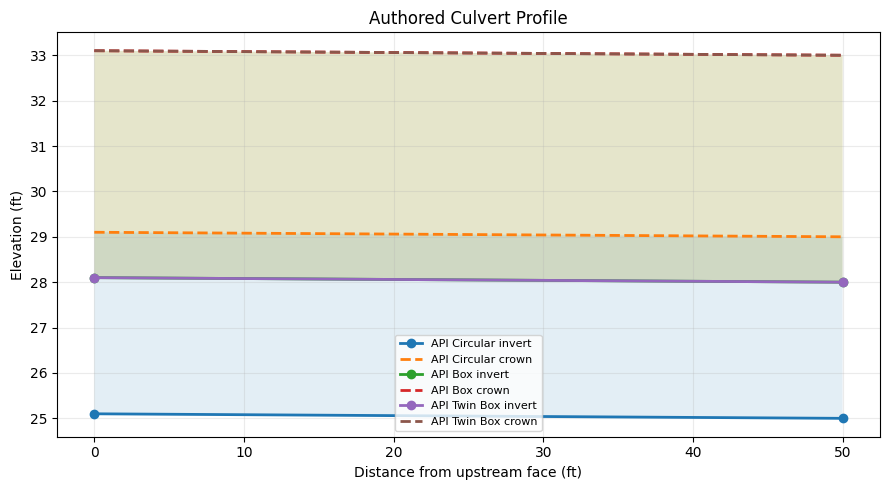
Longitudinal Culvert Profile
Python profile_rows = []
for _ , culvert in round_trip_culverts . iterrows ():
height = culvert [ "Rise" ] if pd . notna ( culvert [ "Rise" ]) else culvert [ "Span" ]
for end , distance , invert in [
( "upstream" , 0.0 , culvert [ "UpstreamInvert" ]),
( "downstream" , culvert [ "Length" ], culvert [ "DownstreamInvert" ]),
]:
profile_rows . append ({
"CulvertName" : culvert [ "CulvertName" ],
"ShapeName" : culvert [ "ShapeName" ],
"End" : end ,
"Distance" : distance ,
"Invert" : invert ,
"Crown" : invert + height ,
"OpeningHeight" : height ,
})
culvert_profile = pd . DataFrame ( profile_rows )
display ( culvert_profile )
fig , ax = plt . subplots ( figsize = ( 9 , 5 ))
for name , group in culvert_profile . groupby ( "CulvertName" , sort = False ):
ordered = group . sort_values ( "Distance" )
ax . plot ( ordered [ "Distance" ], ordered [ "Invert" ], marker = "o" , linewidth = 2 , label = f " { name } invert" )
ax . plot ( ordered [ "Distance" ], ordered [ "Crown" ], linestyle = "--" , linewidth = 2 , label = f " { name } crown" )
ax . fill_between (
ordered [ "Distance" ],
ordered [ "Invert" ],
ordered [ "Crown" ],
alpha = 0.12 ,
)
ax . set_title ( "Authored Culvert Profile" )
ax . set_xlabel ( "Distance from upstream face (ft)" )
ax . set_ylabel ( "Elevation (ft)" )
ax . grid ( True , alpha = 0.25 )
ax . legend ( loc = "best" , fontsize = 8 )
fig . tight_layout ()
plt . show ()
CulvertName
ShapeName
End
Distance
Invert
Crown
OpeningHeight
0
API Circular
Circular
upstream
0.0
25.1
29.1
4.0
1
API Circular
Circular
downstream
50.0
25.0
29.0
4.0
2
API Box
Box
upstream
0.0
28.1
33.1
5.0
3
API Box
Box
downstream
50.0
28.0
33.0
5.0
4
API Twin Box
Box
upstream
0.0
28.1
33.1
5.0
5
API Twin Box
Box
downstream
50.0
28.0
33.0
5.0
Compute The Edited Plan
Python start = time . perf_counter ()
compute_result = RasCmdr . compute_plan (
PLAN_NUMBER ,
ras_object = ras_obj ,
force_geompre = True ,
force_rerun = True ,
num_cores = NUM_CORES ,
verify = True ,
)
runtime_sec = time . perf_counter () - start
data_errors_path = plan_path . parent / f " { plan_path . name } .data_errors.txt"
if data_errors_path . exists ():
raise RuntimeError ( data_errors_path . read_text ( encoding = "utf-8" , errors = "replace" ))
if not compute_result :
raise RuntimeError ( f "HEC-RAS compute failed for plan { PLAN_NUMBER } : { compute_result !r} " )
hdf_path = Path ( ras_obj . plan_df . loc [
ras_obj . plan_df [ "plan_number" ] . astype ( str ) . str . zfill ( 2 ) . eq ( PLAN_NUMBER ),
"HDF_Results_Path" ,
] . iloc [ 0 ])
messages = HdfResultsPlan . get_compute_messages ( PLAN_NUMBER , ras_object = ras_obj )
profiles = HdfResultsPlan . get_steady_profile_names ( PLAN_NUMBER , ras_object = ras_obj )
validation = pd . DataFrame ([{
"Compute Result" : repr ( compute_result ),
"Runtime (s)" : round ( runtime_sec , 2 ),
"Results HDF Exists" : hdf_path . exists (),
"Profiles" : ", " . join ( profiles ),
"Data Errors File Exists" : data_errors_path . exists (),
"Compute Message Characters" : len ( messages ),
}])
display ( validation )
print ( messages [: 700 ])
Compute Result
Runtime (s)
Results HDF Exists
Profiles
Data Errors File Exists
Compute Message Characters
0
ComputeResult(SUCCESS, results_df_row=available)
2.37
True
5 yr, 10 yr, 25 yr
False
732
Text Only Plan: 'Spring Creek Multiple Culverts' (MULTCULV.p01)
Simulation started at: 01May2026 04:50:37 PM
Writing Plan GIS Data...
Completed Writing Plan GIS Data
Writing Geometry...
Computing Bank Lines
Bank lines generated in 24 ms
Computing Edge Lines
Edge Lines generated in 11 ms
Computing XS Interpolation Surface
XS Interpolation Surface generated in 46 ms
Completed Writing Geometry
Writing Event Conditions ...
Completed Writing Event Condition Data
Steady Flow Simulation HEC-RAS 7.0 April 2026
Finished Steady Flow Simulation
Computations Summary
Computation Task Time(hh:mm:ss)
Completing Geometry, Flow and Plan 1
Steady Flow Computations
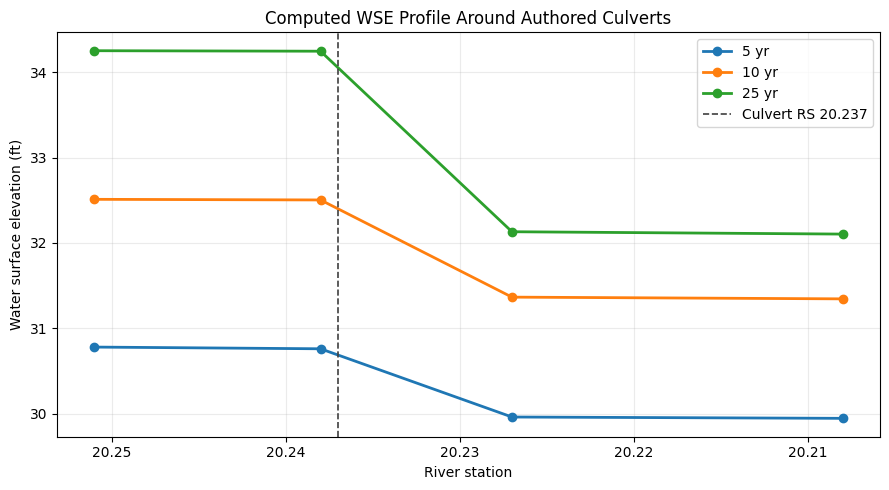
Results Profile Around The Culvert
Python wse_df = HdfResultsPlan . get_steady_wse ( PLAN_NUMBER , ras_object = ras_obj )
wse_df [ "StationNum" ] = wse_df [ "Station" ] . astype ( str ) . str . replace ( "*" , "" , regex = False ) . astype ( float )
window = wse_df [ wse_df [ "StationNum" ] . between ( 20.20 , 20.26 )] . copy ()
display (
window . pivot_table (
index = [ "Station" , "StationNum" ],
columns = "Profile" ,
values = "WSE" ,
) . reset_index () . round ( 3 )
)
fig , ax = plt . subplots ( figsize = ( 9 , 5 ))
for profile , group in window . groupby ( "Profile" , sort = False ):
ordered = group . sort_values ( "StationNum" , ascending = False )
ax . plot ( ordered [ "StationNum" ], ordered [ "WSE" ], marker = "o" , linewidth = 2 , label = profile )
ax . axvline ( float ( rs ), color = "0.25" , linestyle = "--" , linewidth = 1.2 , label = f "Culvert RS { rs } " )
ax . invert_xaxis ()
ax . set_title ( "Computed WSE Profile Around Authored Culverts" )
ax . set_xlabel ( "River station" )
ax . set_ylabel ( "Water surface elevation (ft)" )
ax . grid ( True , alpha = 0.25 )
ax . legend ( loc = "best" )
fig . tight_layout ()
plt . show ()
Profile
Station
StationNum
10 yr
25 yr
5 yr
0
20.208*
20.208
31.345
32.104
29.945
1
20.227
20.227
31.365
32.132
29.961
2
20.238
20.238
32.504
34.247
30.760
3
20.251
20.251
32.511
34.252
30.780
Summary
Python summary = pd . DataFrame ([{
"Authored Culvert Records" : len ( round_trip_culverts ),
"Circular Records" : int (( round_trip_culverts [ "ShapeName" ] == "Circular" ) . sum ()),
"Box Records" : int (( round_trip_culverts [ "ShapeName" ] == "Box" ) . sum ()),
"Multi-Barrel Records" : int (( round_trip_culverts [ "NumBarrels" ] > 1 ) . sum ()),
"Ineffective Flow Updates" : ", " . join ( ineffective_result [ "updated" ]),
"HEC-RAS Compute Success" : bool ( compute_result ),
"Result Profiles" : ", " . join ( profiles ),
}])
display ( summary )
print ( "Culvert authoring workflow complete." )
Authored Culvert Records
Circular Records
Box Records
Multi-Barrel Records
Ineffective Flow Updates
HEC-RAS Compute Success
Result Profiles
0
3
1
2
1
upstream, downstream
True
5 yr, 10 yr, 25 yr
Text Only Culvert authoring workflow complete.
June 11, 2026
June 11, 2026