Performance
This page compares the speed of ras-commander's public methods with the native engine and with h5py, measured for the 0.1.0 release.
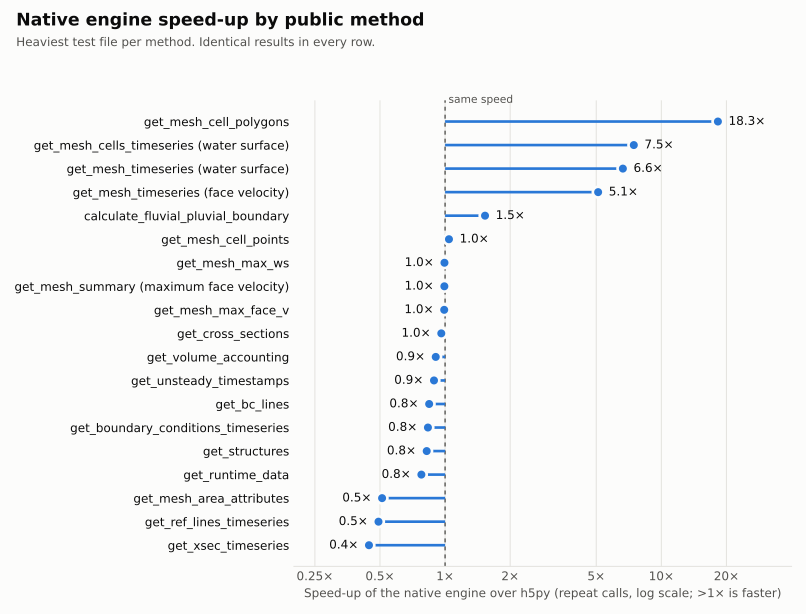
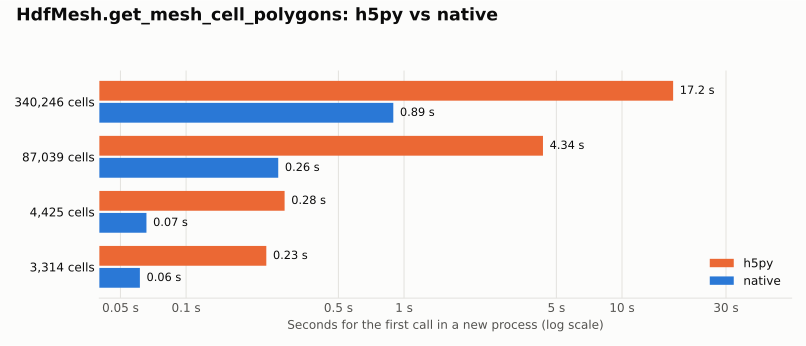
The first chart shows the native speed-up for each benchmarked method; the second shows how the cell-polygon gain changes with mesh size.
Results
Repeat calls (warm) on the heaviest test file for each method, medians of
three fresh processes. Native is the default auto mode; native mode gave
the same timings within noise. Speed-up is h5py time divided by native time.
| Method | Result rows | h5py | Native | Speed-up |
|---|---|---|---|---|
HdfMesh.get_mesh_cell_polygons |
340,246 | 17,145 ms | 939 ms | 18.3× |
HdfResultsMesh.get_mesh_cells_timeseries (water surface) |
1 | 1,372 ms | 184 ms | 7.5× |
HdfResultsMesh.get_mesh_timeseries (water surface) |
193 | 1,415 ms | 213 ms | 6.6× |
HdfResultsMesh.get_mesh_timeseries (face velocity) |
865 | 1,486 ms | 291 ms | 5.1× |
HdfFluvialPluvial.calculate_fluvial_pluvial_boundary |
4,569 | 10,452 ms | 6,831 ms | 1.5× |
HdfMesh.get_mesh_cell_points |
352,141 | 262 ms | 251 ms | 1.0× |
HdfResultsMesh.get_mesh_max_ws |
340,248 | 489 ms | 493 ms | 1.0× |
HdfResultsMesh.get_mesh_summary (maximum face velocity) |
177,301 | 1,732 ms | 1,745 ms | 1.0× |
HdfResultsMesh.get_mesh_max_face_v |
705,332 | 6,974 ms | 7,039 ms | 1.0× |
HdfXsec.get_cross_sections |
1,769 | 81 ms | 84 ms | 1.0× |
HdfResultsPlan.get_volume_accounting |
1 | 1.1 ms | 1.2 ms | 0.9× |
HdfBase.get_unsteady_timestamps |
865 | 5.6 ms | 6.3 ms | 0.9× |
HdfBndry.get_bc_lines |
13 | 12 ms | 15 ms | 0.8× |
HdfResultsMesh.get_boundary_conditions_timeseries |
4 | 51 ms | 62 ms | 0.8× |
HdfStruc.get_structures |
835 | 34 ms | 42 ms | 0.8× |
HdfResultsPlan.get_runtime_data |
1 | 2.7 ms | 3.5 ms | 0.8× |
HdfMesh.get_mesh_area_attributes |
0 | 3.5 ms | 6.8 ms | 0.5× |
HdfResultsXsec.get_ref_lines_timeseries |
11 | 13 ms | 27 ms | 0.5× |
HdfResultsXsec.get_xsec_timeseries |
5 | 13 ms | 29 ms | 0.4× |
- Across all 50 method × file cases (geometric mean), the native engine is 1.07× faster on the first call in a process and 1.30× faster on repeat calls.
- Every case returned identical data in
h5py,autoandnativemode: the benchmark hashed the normalized result (values, dtypes, columns, index, CRS and geometry) of every run. There were 0 errors in 600 runs. - Results with few rows can still be expensive:
get_mesh_cells_timeseriesreturns one cell's series but must locate it in a large compressed dataset.
Benchmark method
- Harness: each measurement runs in a fresh Python process. The mode is
chosen only through
RAS_COMMANDER_FAST_HDF(h5py,auto,native). The three modes are interleaved (h5py, auto, native, native, auto, h5py, ...) so drift affects them equally. Each process records the first call and two repeat calls. - Cases: 19 public methods on 7 HEC-RAS result files, from a 3,314-cell mesh to a mesh of about 340,000 cells and 705,000 faces.
- Machine: Windows 11, Intel Core i7-11700K (8 logical CPUs available to the VM), 48 GB RAM, Python 3.13, h5py 3.14 (HDF5 1.14.6), numpy 2.3, pandas 2.3. No other heavy process ran during the 31-minute run (CPU monitored every 30 s).
- Cache: the operating system's file cache was warm for every column; "first call" means a fresh process, not a cold disk. Cold-disk reads were not measured.
Reading the numbers
- Large gains come from work the engine does in Rust that ras-commander used to do in Python: assembling 2D cell polygons from face topology, and selecting rows or cells from compressed time-series chunks without decompressing more than needed.
- No gain for whole-array summaries: both paths decompress the same chunks with zlib, and that dominates.
- Small losses on small reads come from a fixed cost per native read (opening the session, proving the layout). They are a few milliseconds per call and are the main target for future optimization.