Headless RASMapper Geometry Completion (Edge Lines, Interpolation Surface, Flow Paths)
RASMapper derives several geometry layers from the 1D cross sections — river edge
lines, the XS interpolation surface, and river flow paths — and it can flag
geometry problems through Validate Geometry. RasGeometryCompute drives all of this
in-process via pythonnet (RasMapperLib's RASGeometry), with no GUI and no
RasProcess.exe subprocess.
What you'll learn
- Generate each layer independently with
RasGeometryCompute.generate_edge_lines(),generate_interpolation_surface(), andgenerate_flow_paths(). - Read the results back with the pure-h5py readers
HdfXsec.get_river_edge_lines(),get_xs_interpolation_surface(), andget_river_flow_paths(). - Harvest per-cross-section diagnostics with
validate_geometry()/is_valid_geometry()— HEC-RAS telling you which cut lines to fix. - Run the whole pipeline at once with
compute_geometry(). - Protect manually-edited flow paths with the
overwrite/backupguard.
Prerequisites
- Windows with HEC-RAS 6.6+ installed, and pythonnet (
pip install pythonnet).RasGeometryComputeis Windows-only; on Linux useRasProcess.compute_geometry()(RasProcess.exe + Wine). This notebook skips the generation steps cleanly when HEC-RAS is unavailable. - The generators mutate the geometry HDF in place, so we work on disposable copies.
import sys
import logging
from pathlib import Path

# Prefer the local repository source so the newest APIs are available.
_here = Path.cwd()
for _cand in [_here, *_here.parents]:
    if (_cand / "ras_commander" / "__init__.py").exists():
        sys.path.insert(0, str(_cand))
        break

import matplotlib.pyplot as plt

import ras_commander
from ras_commander import RasExamples, init_ras_project, RasPrj, RasGeometryCompute
from ras_commander.hdf import HdfXsec
from ras_commander.dotnet.clr_bootstrap import is_hecras_available

logging.getLogger("ras_commander").setLevel(logging.CRITICAL)
print("ras_commander:", ras_commander.__file__)

HECRAS_AVAILABLE = is_hecras_available()
print("HEC-RAS / pythonnet available:", HECRAS_AVAILABLE)
if not HECRAS_AVAILABLE:
    print("Generation steps will be skipped; readers still run on any stored layers.")


def extract_or_reuse(name, suffix):
    dest = Path.cwd() / "example_projects" / f"{name}_{suffix}"
    if dest.exists() and any(dest.glob("*.prj")):
        return dest
    return RasExamples.extract_project(name, suffix=suffix)


def find_geom_with_xs(project, ras):
    for cand in sorted(Path(project).glob("*.g[0-9][0-9].hdf")):
        xs = HdfXsec.get_cross_sections(cand, ras_object=ras)
        if xs is not None and not xs.empty:
            return cand
    return None


def describe(gdf, label):
    if gdf is None or len(gdf) == 0:
        print(f"  {label}: (empty)")
        return
    print(f"  {label}: rows={len(gdf)} types={sorted(set(gdf.geom_type))} "
          f"valid={bool(gdf.geometry.is_valid.all())}")
c:\Users\bill\anaconda3\envs\rascommander\Lib\site-packages\tqdm\auto.py:21: TqdmWarning: IProgress not found. Please update jupyter and ipywidgets. See https://ipywidgets.readthedocs.io/en/stable/user_install.html
  from .autonotebook import tqdm as notebook_tqdm


ras_commander: H:\CLB-Repos\ras-commander\ras_commander\__init__.py
HEC-RAS / pythonnet available: True
Set up a disposable 1D model
Muncie has a 1D cross-section network. We extract a private copy and confirm it starts with none of the derived layers.
project = extract_or_reuse("Muncie", "geom_completion")
ras = RasPrj()
init_ras_project(project, "6.6", ras_object=ras)
geom_hdf = find_geom_with_xs(project, ras)
print("Geometry HDF:", geom_hdf.name)

# Baseline: none of the derived layers exist yet.
describe(HdfXsec.get_river_edge_lines(geom_hdf), "edge lines (before)")
describe(HdfXsec.get_xs_interpolation_surface(geom_hdf), "interpolation surface (before)")
describe(HdfXsec.get_river_flow_paths(geom_hdf), "flow paths (before)")
Geometry HDF: Muncie.g01.hdf
  edge lines (before): rows=2 types=['LineString'] valid=True


  interpolation surface (before): rows=60 types=['Polygon'] valid=True
  flow paths (before): rows=2 types=['LineString'] valid=True
Generate river edge lines
generate_edge_lines() runs RASMapper's Create Edge Lines at XS Limits and writes
HEC-RAS's own bank-line-anchored offset-curve edge lines (with the Source Data Hash
HEC-RAS honors) into Geometry/River Edge Lines.
if HECRAS_AVAILABLE:
    result = RasGeometryCompute.generate_edge_lines(geom_hdf, ras_object=ras, overwrite=True)
    print(result)

edges = HdfXsec.get_river_edge_lines(geom_hdf)
describe(edges, "edge lines")
if not edges.empty:
    print("  bank sides:", list(edges["bank_side"]))
2026-07-15 21:00:39 - pyogrio._io - INFO - Created 2 records


GeometryLayerResult(SUCCESS, layer='River Edge Lines', time=2.8s)
  edge lines: rows=2 types=['LineString'] valid=True
  bank sides: ['Left', 'Right']
Generate the XS interpolation surface
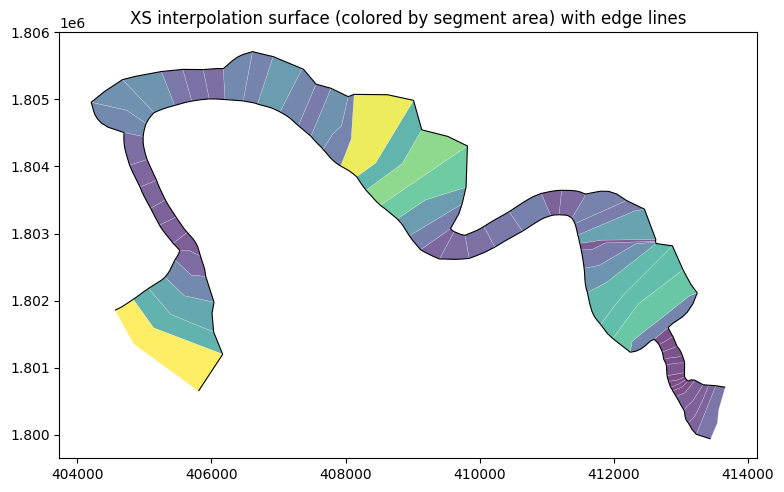
generate_interpolation_surface() runs Compute XS Interpolation Surface. HEC-RAS
self-ensures bank lines and edge lines first. The reader returns one dissolved polygon
per XS-to-XS segment, tagged with the upstream/downstream cross-section ids and area.
if HECRAS_AVAILABLE:
    result = RasGeometryCompute.generate_interpolation_surface(geom_hdf, ras_object=ras, overwrite=True)
    print(result)

surface = HdfXsec.get_xs_interpolation_surface(geom_hdf)
describe(surface, "interpolation surface (per XS segment)")
if not surface.empty:
    display(surface[["surface_id", "us_xs_id", "ds_xs_id", "area"]].head())
    fig, ax = plt.subplots(figsize=(9, 6))
    surface.plot(ax=ax, column="area", cmap="viridis", alpha=0.7, edgecolor="white", linewidth=0.2)
    edges.plot(ax=ax, color="black", linewidth=0.8)
    ax.set_title("XS interpolation surface (colored by segment area) with edge lines")
    ax.set_aspect("equal")
    plt.show()
2026-07-15 21:00:43 - pyogrio._io - INFO - Created 60 records


GeometryLayerResult(SUCCESS, layer='Cross Section Interpolation Surfaces', time=2.2s)


  interpolation surface (per XS segment): rows=60 types=['Polygon'] valid=True
| surface_id | us_xs_id | ds_xs_id | area | |
|---|---|---|---|---|
| 0 | 0 | 0 | 1 | 150401.703125 |
| 1 | 1 | 1 | 2 | 86120.062500 |
| 2 | 2 | 2 | 3 | 75491.640625 |
| 3 | 3 | 3 | 4 | 72046.289062 |
| 4 | 4 | 4 | 5 | 29044.537109 |
Generate river flow paths — with overwrite/backup safety
generate_flow_paths() runs Create Flow Paths from XS Layout. HEC-RAS keeps no cache
hash for flow paths, so any regeneration replaces them unconditionally. To protect
manually defined or optimized flow paths, this method defaults to skip-if-exists
(overwrite=False). Use HdfXsec.get_river_flow_paths() to check first; pass
overwrite=True to regenerate, and with backup=True (default) the existing flow paths
are exported to a dated .geojson.bak sidecar before being replaced.
if HECRAS_AVAILABLE:
    # First generation (none exist yet).
    print(RasGeometryCompute.generate_flow_paths(geom_hdf, ras_object=ras))

    # Calling again without overwrite is a no-op — manual edits are safe.
    print(RasGeometryCompute.generate_flow_paths(geom_hdf, ras_object=ras))

    # Force a regeneration; the existing flow paths are backed up first.
    forced = RasGeometryCompute.generate_flow_paths(geom_hdf, ras_object=ras,
                                                     overwrite=True, backup=True)
    print(forced)
    if forced.backup_path:
        print("  backup written:", forced.backup_path.name)

flow_paths = HdfXsec.get_river_flow_paths(geom_hdf)
describe(flow_paths, "flow paths")
GeometryLayerResult(SKIPPED, layer='River Flow Paths', time=0.0s)


GeometryLayerResult(SKIPPED, layer='River Flow Paths', time=0.0s)


2026-07-15 21:00:45 - pyogrio._io - INFO - Created 2 records


GeometryLayerResult(SUCCESS, layer='River Flow Paths', time=1.1s)
  backup written: Muncie.g01.flow_paths.20260715_210045.geojson.bak


  flow paths: rows=2 types=['LineString'] valid=True
Validate geometry — which cross sections need attention
Overlapping cut lines, self-intersecting edge lines, irregular cross sections, and high
channel sinuosity can block edge-line and interpolation-surface generation.
validate_geometry() returns HEC-RAS's own per-feature diagnostics — severity, the
offending River/Reach/RS, and the message — so you know exactly which cut lines to fix.
if HECRAS_AVAILABLE:
    diagnostics = RasGeometryCompute.validate_geometry(geom_hdf, ras_object=ras)
    print(f"{len(diagnostics)} diagnostic(s); geometry valid (no ERROR): "
          f"{RasGeometryCompute.is_valid_geometry(geom_hdf, ras_object=ras)}")
    if not diagnostics.empty:
        display(diagnostics[["severity", "layer", "River", "Reach", "RS", "message"]])
else:
    print("HEC-RAS unavailable; skipping validation.")
4 diagnostic(s); geometry valid (no ERROR): False
| severity | layer | River | Reach | RS | message | |
|---|---|---|---|---|---|---|
| 0 | ERROR | Cross Sections | White | Muncie | 1980.776 | XS Profile length is different than Polyline l... |
| 1 | ERROR | Cross Sections | White | Muncie | 1980.776 | Right Bank Station point is different than the... |
| 2 | ERROR | Bank Lines, Flow Paths | NaN | NaN | NaN | Bankline intersected FlowPathLine |
| 3 | ERROR | Bank Lines, Flow Paths | NaN | NaN | NaN | Bankline intersected FlowPathLine |
Run the whole pipeline at once
compute_geometry() is the in-process equivalent of RASMapper's Compute Geometry
(and of RasProcess.compute_geometry() on Linux). It generates edge lines, the
interpolation surface, bank lines, ineffective areas, blocked obstructions, and 2D
property tables in one call. Flow paths are not part of this pipeline — generate
those separately with generate_flow_paths().
if HECRAS_AVAILABLE:
    fresh = extract_or_reuse("Muncie", "geom_completion_bundled")
    ras2 = RasPrj()
    init_ras_project(fresh, "6.6", ras_object=ras2)
    fresh_geom = find_geom_with_xs(fresh, ras2)
    result = RasGeometryCompute.compute_geometry(fresh_geom, ras_object=ras2, overwrite=True)
    print(result)
    print("  edge lines:", result.edge_lines_written)
    print("  interpolation surface:", result.interpolation_surface_written)
    print("  flow paths (expected False — not part of the pipeline):", result.flow_paths_written)
else:
    print("HEC-RAS unavailable; skipping compute_geometry.")
2026-07-15 21:00:51 - pyogrio._io - INFO - Created 2 records


GeometryCompleteResult(SUCCESS, edge_lines=True, interp_surface=True, flow_paths=False, time=2.5s)
  edge lines: True
  interpolation surface: True
  flow paths (expected False — not part of the pipeline): False
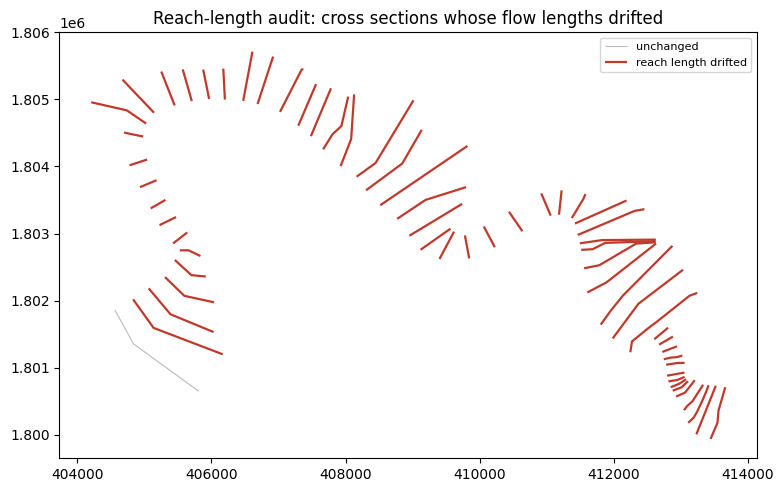
Audit reach lengths (flow lengths) against the current cut lines
A 1D unsteady model requires LOB / channel / ROB reach lengths on every cross section;
HEC-RAS measures those along the flow paths, so they go stale when cut lines move.
audit_reach_lengths() copies the whole project (the original is never touched), recomputes
the reach lengths from the flow paths on the copy, and returns a per-XS before/after diff so
you can see which lengths drifted. By default it leaves existing (possibly hand-edited) flow
paths untouched and generates them only when absent.
if HECRAS_AVAILABLE:
    import hashlib
    before_hash = hashlib.md5(geom_hdf.read_bytes()).hexdigest()

    audit = RasGeometryCompute.audit_reach_lengths(geom_hdf, ras_object=ras)
    print(f"cross sections audited: {len(audit)}")
    print(f"reach-length values changed (> tolerance): {audit.attrs['changed_count']}")
    print(f"used existing flow paths: {audit.attrs['used_existing_flow_paths']}")

    # The audit copies the whole project; the original geometry HDF is never modified.
    assert hashlib.md5(geom_hdf.read_bytes()).hexdigest() == before_hash, "audit modified the original!"
    assert audit.attrs["changed_count"] > 0          # stock Muncie authored lengths have drifted
    assert bool(audit["reach_end"].any())            # each reach's downstream terminus is flagged

    changed = audit[audit["changed"]]
    display(changed[["River", "Reach", "RS",
                     "len_left_stored", "len_left_recomputed", "delta_left",
                     "len_right_stored", "len_right_recomputed", "delta_right"]].head(8))

    # Map the cross sections whose reach lengths drifted.
    fig, ax = plt.subplots(figsize=(9, 6))
    audit[~audit["changed"]].plot(ax=ax, color="#bbbbbb", linewidth=0.8, label="unchanged")
    if not changed.empty:
        changed.plot(ax=ax, color="#c0392b", linewidth=1.6, label="reach length drifted")
    ax.set_title("Reach-length audit: cross sections whose flow lengths drifted")
    ax.set_aspect("equal")
    ax.legend(loc="best", fontsize=8)
    plt.show()

    print("\nChecks passed: original geometry untouched; reach-length drift detected.")
else:
    print("HEC-RAS unavailable; skipping reach-length audit.")
cross sections audited: 61
reach-length values changed (> tolerance): 60
used existing flow paths: True
| River | Reach | RS | len_left_stored | len_left_recomputed | delta_left | len_right_stored | len_right_recomputed | delta_right | |
|---|---|---|---|---|---|---|---|---|---|
| 0 | White | Muncie | 15696.24 | 228.660004 | 229.000000 | 0.339996 | 167.839996 | 189.300003 | 21.460007 |
| 1 | White | Muncie | 15485.51 | 121.230003 | 124.599998 | 3.369995 | 103.790001 | 115.300003 | 11.510002 |
| 2 | White | Muncie | 15370.43 | 174.809998 | 180.699997 | 5.889999 | 117.820000 | 142.100006 | 24.280006 |
| 3 | White | Muncie | 15205.29 | 216.559998 | 227.399994 | 10.839996 | 159.110001 | 182.500000 | 23.389999 |
| 4 | White | Muncie | 15013.20 | 98.059998 | 100.000000 | 1.940002 | 84.000000 | 105.900002 | 21.900002 |
| 5 | White | Muncie | 14917.36 | 60.310001 | 60.200001 | -0.110001 | 51.130001 | 54.400002 | 3.270000 |
| 6 | White | Muncie | 14856.24 | 81.169998 | 90.900002 | 9.730003 | 51.970001 | 54.799999 | 2.829998 |
| 7 | White | Muncie | 14787.40 | 88.660004 | 89.900002 | 1.239998 | 73.830002 | 78.900002 | 5.070000 |
Checks passed: original geometry untouched; reach-length drift detected.
Key takeaways
RasGeometryComputedrives RASMapper's geometry completion in-process (pythonnet), Windows only. On Linux, useRasProcess.compute_geometry()(RasProcess.exe + Wine).- Generate layers individually (
generate_edge_lines/generate_interpolation_surface/generate_flow_paths) or all at once (compute_geometry). Flow paths are separate —compute_geometrydoes not create them. - Read results with the pure-h5py
HdfXsecreaders (get_river_edge_lines,get_xs_interpolation_surface,get_river_flow_paths) — no HEC-RAS needed to read. generate_flow_paths()never clobbers existing flow paths by default (skip-if-exists);overwrite=Truebacks them up to a dated.geojson.bakfirst.audit_reach_lengths()copies the project, recomputes reach lengths from the flow paths, and reports which cross sections' LOB/channel/ROB lengths drifted — a QA step after editing cut lines (a 1D unsteady model needs current reach lengths).validate_geometry()surfaces HEC-RAS's per-cross-section problems so you can fix the offending cut lines;is_valid_geometry()is the boolean gate.