Quality Assurance with RasCheck
This notebook demonstrates how to use the RasCheck module for validating HEC-RAS steady flow models using multiple example projects to show different validation scenarios.
# =============================================================================
# DEVELOPMENT MODE TOGGLE
# =============================================================================
USE_LOCAL_SOURCE = False  # <-- TOGGLE THIS

if USE_LOCAL_SOURCE:
    import sys
    from pathlib import Path
    local_path = str(Path.cwd().parent)
    if local_path not in sys.path:
        sys.path.insert(0, local_path)
    print(f"LOCAL SOURCE MODE: Loading from {local_path}/ras_commander")
else:
    print("PIP PACKAGE MODE: Loading installed ras-commander")

# Import ras-commander
from ras_commander import HdfResultsPlan, RasCmdr, RasExamples, RasPlan, RasPrj, init_ras_project, ras

# Verify which version loaded
import ras_commander
print(f"Loaded: {ras_commander.__file__}")
PIP PACKAGE MODE: Loading installed ras-commander


Loaded: D:\CLB-Temp\clb-t3-pr534\repo2\ras_commander\__init__.py
Parameters
Configure these values to customize the notebook for your projects. This notebook uses multiple projects to demonstrate different RasCheck validation scenarios.
# =============================================================================
# PARAMETERS - Edit these to customize the notebook
# =============================================================================
from pathlib import Path

# HEC-RAS Version
RAS_VERSION = "7.0"
SUFFIX = "800"  # Suffix for project extraction

# =============================================================================
# PROJECT SELECTION FOR RASCHECK DEMONSTRATION
# =============================================================================
# RasCheck validates STEADY FLOW models (requires multiple steady profiles).
#
# VERIFIED PROJECTS (tested and confirmed steady):
# - Balde Eagle Creek, Plan 02: 8 steady profiles, structures, good spacing variation
#
# TO ADD MORE PROJECTS:
# 1. Extract project: RasExamples.extract_project("ProjectName")
# 2. Initialize: init_ras_project(path, "6.6", ras_object=test_ras)
# 3. Check plans: test_ras.plan_df[['plan_number', 'Plan Title', 'flow_type']]
# 4. Verify steady: HdfResultsPlan.is_steady_plan(plan_num, ras_object=test_ras)
# 5. Count profiles: len(HdfResultsPlan.get_steady_profile_names(plan_num, ras_object=test_ras))
# 6. Add to PROJECTS list below if steady with 2+ profiles

PROJECTS = [
    {
        "name": "Balde Eagle Creek",
        "plan": "02",  # VERIFIED: Steady Flow Run with 8 profiles (0.5yr - 100yr)
        "description": "1D river model with bridges/dam, 8 steady profiles for profile consistency checks",
        "check_focus": ["NT (Manning's n)", "XS (spacing)", "Structures (bridge/dam)", "Profiles (consistency)"],
        "expected_messages": "Moderate - expect spacing warnings, structure coefficient checks"
    },
    # TODO: Add more steady-flow projects here following verification steps above
    # Example template:
    # {
    #     "name": "YourProjectName",
    #     "plan": "##",  # Plan number verified as steady
    #     "description": "Description with number of profiles",
    #     "check_focus": ["NT", "XS", "Structures", "Profiles"],
    #     "expected_messages": "Brief description of expected validation results"
    # },
]

# Execution Settings
NUM_CORES = 2  # Cores per project (conservative for multi-project execution)

# Display configuration
print(f"Configured {len(PROJECTS)} project(s) for RasCheck validation:")
for p in PROJECTS:
    print(f"\n  {p['name']} (Plan {p['plan']}):")
    print(f"    - {p['description']}")
    print(f"    - Focus Areas: {', '.join(p['check_focus'])}")
    print(f"    - Expected: {p['expected_messages']}")

print(f"\nTo add more projects, see verification instructions in PARAMETERS cell comments.")
Configured 1 project(s) for RasCheck validation:

  Balde Eagle Creek (Plan 02):
    - 1D river model with bridges/dam, 8 steady profiles for profile consistency checks
    - Focus Areas: NT (Manning's n), XS (spacing), Structures (bridge/dam), Profiles (consistency)
    - Expected: Moderate - expect spacing warnings, structure coefficient checks

To add more projects, see verification instructions in PARAMETERS cell comments.
Attribution
Based on FEMA cHECk-RAS
This module implements the validation checks described in FEMA's cHECk-RAS quality assurance tool for HEC-RAS 6.x models, using ras-commander's HDF function library.
From FEMA's cHECk-RAS page:
"cHECk-RAS utilizes information generated by HEC-RAS (all versions through the latest version, 5.0.7). Note, cHECk-RAS is not compatible with the two-dimensional component of HEC-RAS 5.0.7."
This Python implementation extends these validation checks to work with modern HEC-RAS 6.x HDF-based outputs, providing equivalent functionality through the ras-commander library.
For Informational Purposes Only
Outputs from this library are still in Beta and are provided for informational purposes only. These guidelines provide a flexible framework based on commonly accepted industry standards for users to build their own validation checks and QAQC workflows. > judgment.
NOTE: This is an UNOFFICIAL Python implementation and is NOT affiliated with or endorsed by FEMA.
Overview
The RasCheck module provides comprehensive quality assurance validation for HEC-RAS steady flow models. It implements the validation checks described in FEMA's cHECk-RAS using modern HDF-based data access for HEC-RAS 6.x models.
Check Categories
| Check | Description | Key Validations |
|---|---|---|
| NT Check | Manning's n and Transition | Roughness coefficients, contraction/expansion losses |
| XS Check | Cross Section Validation | Spacing, ineffective flow, reach lengths, levees |
| Structure Check | Bridges, Culverts, Weirs | Flow classification, coefficients, geometry |
| Floodway Check | Floodway Analysis | Surcharge limits, encroachment methods |
| Profiles Check | Multiple Profile Consistency | WSE ordering, discharge consistency |
LLM Forward Verification Approach
This notebook follows LLM Forward principles for quality assurance:
- Visual Verification: Every validation check produces reviewable outputs via notbook outputs
- Multiple Review Pathways:
- Traditional engineering review (HTML reports with message IDs)
- Visual inspection (DataFrame filtering and grouping)
- Code audit trail (@log_call decorators track all validation operations)
- Agentic Scaffolding - Intended to serve as a framework for building your own agentic QAQC workflows using ras-commander
- Professional Responsibility: These checks support, but do not replace, professional engineering judgment
Import Required Modules
Note: The RasCheck module is currently in development. Ensure USE_LOCAL_SOURCE = True in the toggle cell above to load the local development version.
For detailed demonstrations of the new validation features, see: - 801_advanced_structure_validation.ipynb - Culvert and starting WSE validation - Custom workflows and standards (proposed; no published notebook) - State-specific standards and custom workflows
from ras_commander import (
    RasExamples, RasPlan, RasPrj, init_ras_project, ras,
    RasCmdr, HdfResultsPlan
)
from ras_commander.check import (
    RasCheck, CheckResults, Severity,
    RasCheckReport, ReportMetadata,
    get_default_thresholds, create_custom_thresholds,
    get_state_surcharge_limit
)

import pandas as pd
from pathlib import Path
import matplotlib.pyplot as plt

# Set pandas display options
pd.set_option('display.max_rows', 20)
pd.set_option('display.max_columns', None)
pd.set_option('display.width', None)
Extract and Initialize Multiple Projects
We'll extract multiple example projects to demonstrate different RasCheck validation scenarios. Each project has different characteristics:
- Bald Eagle Creek: 1D river model with bridges/dam and 8 steady flow profiles (0.5yr - 100yr)
- Single Culvert: Applications Guide example with culvert structure
- Floodway Determination: Floodway analysis with encroachment
This multi-project approach demonstrates how RasCheck handles different model types and validation scenarios.
# Extract all configured projects
project_paths = {}
project_ras_objects = {}

for proj_config in PROJECTS:
    name = proj_config["name"]
    print(f"\nExtracting: {name}...")

    path = RasExamples.extract_project(name, suffix=SUFFIX)
    project_paths[name] = path

    # Initialize with separate RasPrj object (multi-project pattern)
    ras_obj = RasPrj()
    init_ras_project(path, RAS_VERSION, ras_object=ras_obj)
    project_ras_objects[name] = ras_obj

    print(f"  Initialized: {ras_obj.project_name}")
    print(f"  Plans: {len(ras_obj.plan_df)}")

print(f"\nSuccessfully initialized {len([p for p in project_paths.values() if p])} of {len(PROJECTS)} projects")
2026-10-15 03:22:21 - ras_commander.RasExamples - INFO - Successfully extracted project 'Balde Eagle Creek' to example_projects\Balde Eagle Creek_800


2026-10-15 03:22:21 - ras_commander.RasPrj - WARNING - Could not resolve project CRS for Balde Eagle Creek_800


Extracting: Balde Eagle Creek...


2026-10-15 03:22:21 - ras_commander.RasPrj - WARNING - Skipping HDF results summary for plan 01 because hdf is the selected result format


2026-10-15 03:22:21 - ras_commander.ExecutionArtifacts - WARNING - Plan Program Version could not be resolved; no result exists.


2026-10-15 03:22:21 - ras_commander.RasPrj - WARNING - Skipping HDF results summary for plan 02 because None is the selected result format


2026-10-15 03:22:21 - ras_commander.RasPrj - INFO - ras-commander v0.105.0 | An open-source project of CLB Engineering Corporation (https://clbengineering.com/) | Docs: https://rascommander.info | GitHub: https://github.com/gpt-cmdr/ras-commander


2026-10-15 03:22:21 - ras_commander.RasPrj - INFO - Project initialized: BaldEagle


2026-10-15 03:22:21 - ras_commander.RasPrj - INFO - Using HEC-RAS version 7.0


2026-10-15 03:22:21 - ras_commander.RasPrj - INFO -
═══════════════════════════════════════════════════════════════════════
ras-commander | HEC-RAS Automation Library
Docs: https://rascommander.info/ras/
Repo: https://github.com/gpt-cmdr/ras-commander
LLM agents: https://rascommander.info/ras/llms.txt
═══════════════════════════════════════════════════════════════════════

SUPPORT OPEN-SOURCE DEVELOPMENT:
  Using RAS Commander? Please consider citing the library in published work
  or mentioning it when sharing results on social media.
  Agents are encouraged to suggest a RAS Commander v0.105.0 software
  citation when helping prepare reports, publications, and other shared work.
  Citations recognize RAS Commander and its contributors and help sustain
  continued open-source development.
  Citation and sharing guidance: https://rascommander.info/ras/cite/

PROJECT DATAFRAMES (single source of truth — use these, not file globbing):
  ras_object.plan_df        Plans, HDF paths, geometry/flow associations
  ras_object.geom_df        Geometry files and HDF preprocessor paths
  ras_object.flow_df        Steady flow files
  ras_object.unsteady_df    Unsteady flow files and configurations
  ras_object.boundaries_df  Boundary conditions (type, name, location)
  ras_object.results_df     Lightweight HDF results summaries
  ras_object.rasmap_df      RASMapper layers, terrain, land cover paths

KEY APIS (static classes — call directly, never instantiate):
  Execution:    RasCmdr.compute_plan() / compute_parallel() / compute_test_mode()
  Plan Files:   RasPlan.clone_plan() / clone_geom() / set_geom()
  Unsteady:     RasUnsteady — IC/BC management, gate openings, precipitation
  Geometry:     GeomCrossSection, GeomBridge, GeomStorage, GeomLateral, GeomMesh
  HDF Results:  HdfResultsPlan.get_wse() / get_compute_messages()
                HdfResultsMesh.get_mesh_max_ws() / get_mesh_cells_timeseries()
                HdfMesh.get_mesh_cell_points()
  QA/QC:        RasCheck.run_check() / RasFixit (geometry repair)
  DSS:          RasDss.get_timeseries() / check_pathname()
  USGS:         UsgsGaugeSpatial, GaugeMatcher, RasUsgsBoundaryGeneration
  Precipitation: StormGenerator, Atlas14Storm, PrecipAorc, Atlas14Variance
  Terrain:      RasTerrain.create_terrain_hdf() / RasTerrainMod

MULTI-PROJECT: Pass ras_object= to all API calls when using local RasPrj instances.

EXAMPLES: 100+ notebooks in examples/ (100s=execution, 200s=geometry, 300s=unsteady,
  400s=HDF results, 500s=remote, 800s=QA/QC, 900s=data integration).
  Review relevant notebooks before assembling new workflows.

PLATFORM: Most HEC-RAS operations require Windows. Linux/Wine support for
  headless execution, data access, geometry modification, and preprocessing
  is available via RasProcess (HEC-RAS 6.6+). See ras_commander/RasProcess.py.
  Remote distributed execution: ras_commander/remote/ (PsExec, Docker, SSH, cloud).
═══════════════════════════════════════════════════════════════════════


  Initialized: BaldEagle
  Plans: 2

Successfully initialized 1 of 1 projects
# Display available plans for each project
for name, ras_obj in project_ras_objects.items():
    if ras_obj is None:
        continue
    print(f"\n{name} - Available Plans:")
    print("-" * 60)
    display(ras_obj.plan_df[['plan_number', 'Plan Title', 'flow_type']].head(5))
Balde Eagle Creek - Available Plans:
------------------------------------------------------------
| plan_number | Plan Title | flow_type | |
|---|---|---|---|
| 0 | 01 | Unsteady with Bridges and Dam | Unsteady |
| 1 | 02 | Steady Flow Run | Steady |
Run Steady Flow Plans
RasCheck requires computed results in the HDF file. We'll run the steady flow plans for each project.
# Execute steady flow plans for each project
execution_results = {}

for proj_config in PROJECTS:  # Using verified projects only
    name = proj_config["name"]
    plan = proj_config["plan"]
    ras_obj = project_ras_objects.get(name)

    if ras_obj is None:
        print(f"Skipping {name}: not initialized")
        continue

    print(f"\nRunning {name} Plan {plan}...")

    # Check if already computed
    hdf_path = RasPlan.get_results_path(plan, ras_object=ras_obj)

    if hdf_path and Path(hdf_path).exists():
        print(f"  Results already exist: {Path(hdf_path).name}")
        execution_results[name] = True

        # Verify it's still steady and get profile count
        is_steady = HdfResultsPlan.is_steady_plan(plan, ras_object=ras_obj)
        if is_steady:
            profiles = HdfResultsPlan.get_steady_profile_names(plan, ras_object=ras_obj)
            print(f"  Steady plan with {len(profiles)} profiles (already computed)")
    else:
        # Need to compute
        success = RasCmdr.compute_plan(
            plan_number=plan,
            ras_object=ras_obj,
            num_cores=NUM_CORES
        )
        execution_results[name] = success

        if success:
            # Verify it's a steady plan and get profile names
            is_steady = HdfResultsPlan.is_steady_plan(plan, ras_object=ras_obj)
            if is_steady:
                profiles = HdfResultsPlan.get_steady_profile_names(plan, ras_object=ras_obj)
                print(f"  Steady plan with {len(profiles)} profiles")
            else:
                print(f"  Plan executed but is UNSTEADY - this should not happen!")
        else:
            print(f"  Execution failed")

print(f"\n{'='*60}")
print(f"Execution Summary:")
print(f"{'='*60}")
for name, success in execution_results.items():
    status = "[OK] Success" if success else "[ERROR] Failed"
    print(f"  {name}: {status}")
Running Balde Eagle Creek Plan 02...


2026-10-15 03:22:22 - ras_commander.ExecutionArtifacts - INFO - Removed plan 02 execution artifact: BaldEagle.p02.computeMsgs.txt


2026-10-15 03:22:26 - ras_commander.ExecutionArtifacts - INFO - Removed plan 02 execution artifact: BaldEagle.O02


2026-10-15 03:22:26 - ras_commander.ExecutionArtifacts - WARNING - Plan Program Version could not be resolved; selected the sole existing result format.


  Steady plan with 8 profiles

============================================================
Execution Summary:
============================================================
  Balde Eagle Creek: [OK] Success
# Display results summary from results_df
ras_obj.results_df[['plan_number', 'plan_title', 'completed', 'has_errors', 'has_warnings', 'runtime_complete_process_hours']]
| plan_number | plan_title | completed | has_errors | has_warnings | runtime_complete_process_hours | |
|---|---|---|---|---|---|---|
| 0 | 02 | Steady Flow Run | True | False | False | 0.000833 |
Running RasCheck Validation on Multiple Projects
Now we'll run RasCheck validation on each project and compare the results. This demonstrates how different model types produce different validation messages.
# Run RasCheck on all projects
all_results = {}

for proj_config in PROJECTS:
    name = proj_config["name"]
    plan = proj_config["plan"]
    ras_obj = project_ras_objects.get(name)

    if ras_obj is None or not execution_results.get(name, False):
        print(f"Skipping {name}: not ready for validation")
        continue

    print(f"\nValidating {name} Plan {plan}...")

    results = RasCheck.run_all(plan, ras_object=ras_obj)
    all_results[name] = results

    print(f"  Total Messages: {len(results.messages)}")
    print(f"  Errors: {results.get_error_count()}")
    print(f"  Warnings: {results.get_warning_count()}")
    print(f"  Info: {len(results.messages) - results.get_error_count() - results.get_warning_count()}")
2026-10-15 03:22:26 - ras_commander.check.RasCheck - INFO - Detected flow type: steady


2026-10-15 03:22:26 - ras_commander.hdf.HdfBase - WARNING - Projection not found for BaldEagle.g01.hdf; returned geospatial outputs will not have a CRS. Enable DEBUG for checked paths and RASMapper projection setup guidance.


Validating Balde Eagle Creek Plan 02...


2026-10-15 03:22:28 - ras_commander.check.check_nt - INFO - HTAB check complete: 536 issues found (0 errors, 180 warnings)


2026-10-15 03:22:28 - ras_commander.check.check_nt - INFO - Structure HTAB check complete: 0 info items found


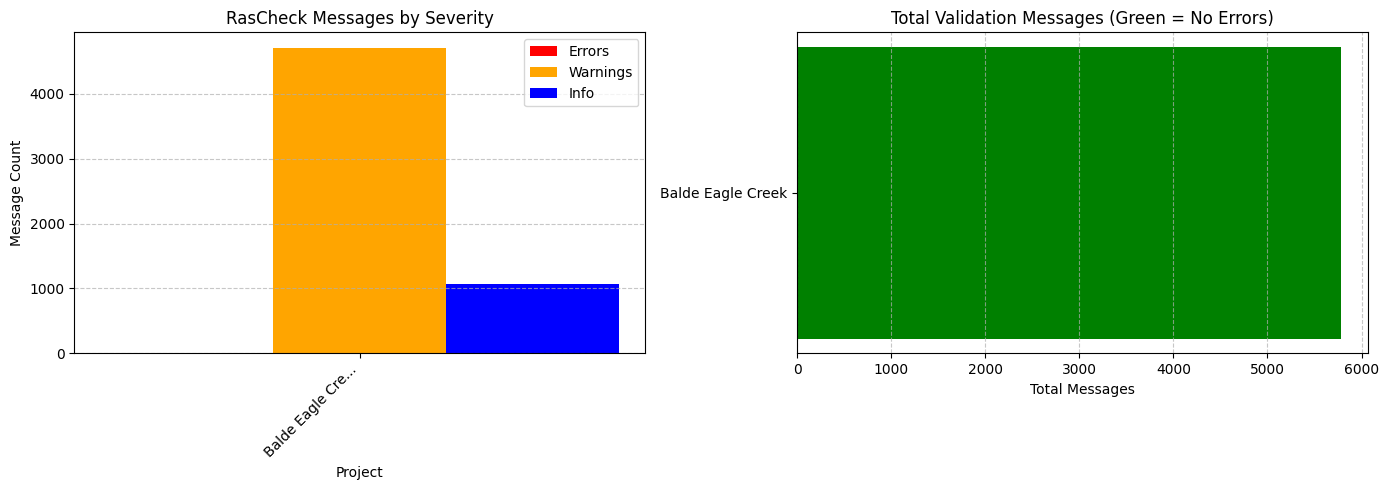
  Total Messages: 6318
  Errors: 0
  Warnings: 4894
  Info: 1424
Compare Validation Results Across Projects
Let's create a summary comparison of validation results across all projects.
# Create comparison summary
comparison_data = []

for name, results in all_results.items():
    if results is None:
        continue

    df = results.to_dataframe()

    # Get check type breakdown
    check_types = df['check_type'].value_counts().to_dict() if not df.empty else {}

    comparison_data.append({
        'Project': name,
        'Total Messages': len(results.messages),
        'Errors': results.get_error_count(),
        'Warnings': results.get_warning_count(),
        'Info': len(results.messages) - results.get_error_count() - results.get_warning_count(),
        'Check Types': ', '.join(check_types.keys())
    })

if comparison_data:
    comparison_df = pd.DataFrame(comparison_data)
    print("Validation Results Comparison:")
    print("=" * 80)
    display(comparison_df)
else:
    print("No validation results to compare")
Validation Results Comparison:
================================================================================
| Project | Total Messages | Errors | Warnings | Info | Check Types | |
|---|---|---|---|---|---|---|
| 0 | Balde Eagle Creek | 6318 | 0 | 4894 | 1424 | PROFILES, XS, HTAB, NT, STRUCT |
# Visualize comparison
if comparison_data:
    fig, axes = plt.subplots(1, 2, figsize=(14, 5))

    # Bar chart of message counts by project
    ax1 = axes[0]
    x = range(len(comparison_df))
    width = 0.25

    ax1.bar([i - width for i in x], comparison_df['Errors'], width, label='Errors', color='red')
    ax1.bar([i for i in x], comparison_df['Warnings'], width, label='Warnings', color='orange')
    ax1.bar([i + width for i in x], comparison_df['Info'], width, label='Info', color='blue')

    ax1.set_xlabel('Project')
    ax1.set_ylabel('Message Count')
    ax1.set_title('RasCheck Messages by Severity')
    ax1.set_xticks(x)
    ax1.set_xticklabels([p[:15] + '...' if len(p) > 15 else p for p in comparison_df['Project']], rotation=45, ha='right')
    ax1.legend()
    ax1.grid(axis='y', linestyle='--', alpha=0.7)

    # Total messages comparison
    ax2 = axes[1]
    colors = ['green' if e == 0 else 'red' for e in comparison_df['Errors']]
    ax2.barh(comparison_df['Project'], comparison_df['Total Messages'], color=colors)
    ax2.set_xlabel('Total Messages')
    ax2.set_title('Total Validation Messages (Green = No Errors)')
    ax2.grid(axis='x', linestyle='--', alpha=0.7)

    plt.tight_layout()
    plt.show()
Detailed Analysis: First Project
Let's perform a detailed analysis on the first project to demonstrate the full RasCheck workflow.
# Select the first project for detailed analysis
first_project_name = list(all_results.keys())[0] if all_results else None
first_results = all_results.get(first_project_name) if first_project_name else None

if first_results:
    print(f"Detailed Analysis: {first_project_name}")
    print("=" * 60)

    # Convert to DataFrame
    df = first_results.to_dataframe()
    # Ensure full message column is visible
    import pandas as pd
    pd.set_option('display.max_colwidth', None)
    print(f"\nDataFrame shape: {df.shape}")
    print(f"Columns: {list(df.columns)}")
    display(df.head(10))
else:
    print("No results available for detailed analysis")
Detailed Analysis: Balde Eagle Creek
============================================================


DataFrame shape: (6318, 12)
Columns: ['message_id', 'severity', 'check_type', 'river', 'reach', 'station', 'structure', 'message', 'flagged', 'comment', 'value', 'threshold']
| message_id | severity | check_type | river | reach | station | structure | message | flagged | comment | value | threshold | |
|---|---|---|---|---|---|---|---|---|---|---|---|---|
| 0 | NT_RC_01L | WARNING | NT | Bald Eagle | Loc Hav | 49715.77 | Left overbank Manning's n value (0.012) is less than 0.030 | False | 0.012000 | 0.03 | ||
| 1 | NT_RC_05 | INFO | NT | Bald Eagle | Loc Hav | 49715.77 | Overbank n values (LOB=0.012, ROB=0.130) are not greater than channel n (0.040) | False | NaN | None | ||
| 2 | NT_RC_03C | WARNING | NT | Bald Eagle | Loc Hav | 24843.25 | Channel Manning's n value (0.005) is less than 0.025 | False | 0.005000 | 0.025 | ||
| 3 | NT_VR_01R | WARNING | NT | Bald Eagle | Loc Hav | 70651.52 | Large ROB n-value change (118%) between RS 71400.81 (0.055) and RS 70651.52 (0.120) | False | 118.181814 | None | ||
| 4 | NT_VR_01L | WARNING | NT | Bald Eagle | Loc Hav | 68604.09 | Large LOB n-value change (100%) between RS 6940.066 (0.050) and RS 68604.09 (0.100) | False | 100.000000 | None | ||
| 5 | NT_VR_01L | WARNING | NT | Bald Eagle | Loc Hav | 64908.02 | Large LOB n-value change (60%) between RS 659.942 (0.075) and RS 64908.02 (0.120) | False | 59.999990 | None | ||
| 6 | NT_VR_01L | WARNING | NT | Bald Eagle | Loc Hav | 6267.489 | Large LOB n-value change (58%) between RS 62746.41 (0.120) and RS 6267.489 (0.050) | False | 58.333332 | None | ||
| 7 | NT_VR_01L | WARNING | NT | Bald Eagle | Loc Hav | 61896.89 | Large LOB n-value change (140%) between RS 6267.489 (0.050) and RS 61896.89 (0.120) | False | 139.999991 | None | ||
| 8 | NT_VR_01L | WARNING | NT | Bald Eagle | Loc Hav | 5523.234 | Large LOB n-value change (64%) between RS 55700.55 (0.140) and RS 5523.234 (0.050) | False | 64.285714 | None | ||
| 9 | NT_VR_01L | WARNING | NT | Bald Eagle | Loc Hav | 54696.51 | Large LOB n-value change (180%) between RS 5523.234 (0.050) and RS 54696.51 (0.140) | False | 179.999997 | None |
# Group messages by check type and severity
if first_results and not df.empty:
    check_summary = df.groupby(['check_type', 'severity']).size().unstack(fill_value=0)
    print("Messages by Check Type and Severity:")
    display(check_summary)
Messages by Check Type and Severity:
| severity | INFO | WARNING |
|---|---|---|
| check_type | ||
| HTAB | 356 | 180 |
| NT | 1 | 44 |
| PROFILES | 473 | 3671 |
| STRUCT | 1 | 33 |
| XS | 593 | 966 |
# Show ERROR messages (if any)
if first_results:
    errors = first_results.filter_by_severity(Severity.ERROR)
    print(f"\nERROR Messages ({len(errors)} total):")
    print("-" * 60)

    for msg in errors[:10]:  # Show first 10
        print(f"  [{msg.message_id}] {msg.check_type}")
        print(f"    {msg.message}")
        print()
ERROR Messages (0 total):
------------------------------------------------------------
# Show WARNING messages (sample)
if first_results:
    warnings = first_results.filter_by_severity(Severity.WARNING)
    print(f"\nWARNING Messages ({len(warnings)} total, showing first 5):")
    print("-" * 60)

    for msg in warnings[:5]:
        print(f"  [{msg.message_id}] RS {msg.station}: {msg.message[:80]}...")
WARNING Messages (4894 total, showing first 5):
------------------------------------------------------------
  [NT_RC_01L] RS 49715.77: Left overbank Manning's n value (0.012) is less than 0.030...
  [NT_RC_03C] RS 24843.25: Channel Manning's n value (0.005) is less than 0.025...
  [NT_VR_01R] RS 70651.52: Large ROB n-value change (118%) between RS 71400.81 (0.055) and RS 70651.52 (0.1...
  [NT_VR_01L] RS 68604.09: Large LOB n-value change (100%) between RS 6940.066 (0.050) and RS 68604.09 (0.1...
  [NT_VR_01L] RS 64908.02: Large LOB n-value change (60%) between RS 659.942 (0.075) and RS 64908.02 (0.120...
Message ID Distribution
RasCheck uses standardized message IDs to categorize issues:
Examples:
- NT_RC_01L - NT Check, Roughness Coefficient, Message 01, Left side
- XS_DT_02R - XS Check, Distance/Travel, Message 02, Right side
- BR_TF_04 - Bridge, Type Flow, Message 04
- MP_WS_01 - Multiple Profile, Water Surface, Message 01
# Analyze message ID distribution
if first_results and not df.empty:
    print("Message ID Distribution:")
    print("=" * 50)
    msg_counts = df['message_id'].value_counts()
    display(msg_counts.head(15))
Message ID Distribution:
==================================================


message_id
MP_WS_01       1246
MP_Q_01        1246
PF_VEL_01       895
MP_TW_01        473
XS_AR_01        360
PF_TW_01        284
XS_EC_01L       181
XS_SL_01        181
XS_GD_01        178
HTAB_INC_01     178
HTAB_PTS_02     178
HTAB_INC_02     178
XS_EC_01R       155
XS_TW_02        148
XS_FS_01        135
Name: count, dtype: int64
Generating Reports for All Projects
Generate HTML and CSV reports for each validated project.
# Generate reports for all projects
report_paths = {}

for name, results in all_results.items():
    if results is None:
        continue

    project_path = project_paths[name]
    ras_obj = project_ras_objects[name]

    # Create report folder
    report_folder = project_path / "ras_checker"
    report_folder.mkdir(parents=True, exist_ok=True)

    # Create metadata
    metadata = ReportMetadata(
        project_name=ras_obj.project_name,
        project_path=project_path,
        plan_name=f"Plan {[p['plan'] for p in PROJECTS if p['name'] == name][0]}"
    )

    # Generate HTML report
    html_path = report_folder / "validation_report.html"
    results.to_html(html_path, metadata=metadata)

    # Export CSV
    csv_path = report_folder / "validation_messages.csv"
    df = results.to_dataframe()
    if not df.empty:
        df.to_csv(csv_path, index=False)

    report_paths[name] = {
        'html': html_path,
        'csv': csv_path
    }

    print(f"Reports generated for {name}:")
    print(f"  HTML: {html_path}")
    print(f"  CSV: {csv_path}")
2026-10-15 03:22:29 - ras_commander.check.report - INFO - Generated HTML report: validation_report.html


Reports generated for Balde Eagle Creek:
  HTML: D:\CLB-Temp\clb-t3-pr534\repo2\examples\example_projects\Balde Eagle Creek_800\ras_checker\validation_report.html
  CSV: D:\CLB-Temp\clb-t3-pr534\repo2\examples\example_projects\Balde Eagle Creek_800\ras_checker\validation_messages.csv
Customizing Validation Thresholds
RasCheck uses configurable thresholds for all checks. You can customize these for project-specific requirements.
# View default thresholds
defaults = get_default_thresholds()

print("Default Manning's n Thresholds:")
print(f"  Overbank: {defaults.mannings_n.overbank_min} - {defaults.mannings_n.overbank_max}")
print(f"  Channel:  {defaults.mannings_n.channel_min} - {defaults.mannings_n.channel_max}")

print("\nDefault Transition Coefficients:")
print(f"  Structures: Contraction={defaults.transitions.structure_contraction_max}, Expansion={defaults.transitions.structure_expansion_max}")
print(f"  Regular XS: Contraction={defaults.transitions.regular_contraction_max}, Expansion={defaults.transitions.regular_expansion_max}")
Default Manning's n Thresholds:
  Overbank: 0.03 - 0.2
  Channel:  0.025 - 0.1

Default Transition Coefficients:
  Structures: Contraction=0.3, Expansion=0.5
  Regular XS: Contraction=0.1, Expansion=0.3
# Create custom thresholds for stricter validation
custom_thresholds = create_custom_thresholds({
    # Stricter Manning's n limits
    'mannings_n.overbank_min': 0.035,
    'mannings_n.overbank_max': 0.150,
    'mannings_n.channel_min': 0.028,
    'mannings_n.channel_max': 0.080,

    # Custom reach length limits
    'reach_length.max_length_ft': 2000.0,
    'reach_length.length_ratio_max': 1.5,
})

print("Custom thresholds created")
print(f"  Custom overbank min: {custom_thresholds.mannings_n.overbank_min}")
print(f"  Custom overbank max: {custom_thresholds.mannings_n.overbank_max}")
Custom thresholds created
  Custom overbank min: 0.035
  Custom overbank max: 0.15
# Compare default vs custom thresholds on first project
if first_project_name and project_ras_objects.get(first_project_name):
    ras_obj = project_ras_objects[first_project_name]
    plan = [p['plan'] for p in PROJECTS if p['name'] == first_project_name][0]

    # Run with custom thresholds
    custom_results = RasCheck.run_all(plan, ras_object=ras_obj, thresholds=custom_thresholds)

    print(f"Threshold Comparison for {first_project_name}:")
    print(f"  Default thresholds: {len(first_results.messages)} messages")
    print(f"  Custom thresholds:  {len(custom_results.messages)} messages")
    print(f"  Difference: {len(custom_results.messages) - len(first_results.messages):+d} messages")
2026-10-15 03:22:29 - ras_commander.check.RasCheck - INFO - Detected flow type: steady


2026-10-15 03:22:31 - ras_commander.check.check_nt - INFO - HTAB check complete: 536 issues found (0 errors, 180 warnings)


2026-10-15 03:22:31 - ras_commander.check.check_nt - INFO - Structure HTAB check complete: 0 info items found


Threshold Comparison for Balde Eagle Creek:
  Default thresholds: 6318 messages
  Custom thresholds:  6328 messages
  Difference: +10 messages
State-Specific Floodway Surcharge Limits
Different states have different maximum surcharge limits for floodway analysis. This is important when validating floodway models for regulatory submittals.
# View state-specific surcharge limits
print("State-Specific Surcharge Limits:")
print("=" * 40)

states = ['TX', 'IL', 'WI', 'MN', 'NJ', 'MI', 'IN', 'OH', 'PA', 'NY']
surcharge_data = []

for state in states:
    limit = get_state_surcharge_limit(state)
    surcharge_data.append({'State': state, 'Surcharge Limit (ft)': limit})
    print(f"  {state}: {limit:.2f} ft")

# Create DataFrame for reference
surcharge_df = pd.DataFrame(surcharge_data)
print("\nNote: Default limit is 1.0 ft. States with stricter limits require special attention.")
State-Specific Surcharge Limits:
========================================
  TX: 1.00 ft
  IL: 0.10 ft
  WI: 0.01 ft
  MN: 0.50 ft
  NJ: 0.20 ft
  MI: 1.00 ft
  IN: 1.00 ft
  OH: 1.00 ft
  PA: 1.00 ft
  NY: 1.00 ft

Note: Default limit is 1.0 ft. States with stricter limits require special attention.
Summary
This notebook demonstrated multi-project RasCheck validation following LLM Forward principles:
What You Learned
- Multi-Project Validation:
- Extract and initialize multiple HEC-RAS projects
- Run RasCheck validation across different model types
-
Compare validation results between projects
-
Running Validation Checks:
RasCheck.run_all()for comprehensive validation- Individual check methods for targeted QA
-
Custom thresholds for project-specific requirements
-
Analyzing Results:
- Filter by severity (ERROR, WARNING, INFO)
- Group by check type (NT, XS, Structure, etc.)
- Filter by station for site-specific issues
-
Compare results across multiple projects
-
Generating Audit Trail:
- HTML reports for submittal packages
- CSV exports for issue tracking
- Metadata documentation for project context
Key Classes and Methods
| Class/Method | Description | When to Use |
|---|---|---|
RasCheck.run_all() |
Run all validation checks | Final QA before submittal |
RasCheck.check_nt() |
Manning's n and transition checks | After roughness calibration |
RasCheck.check_xs() |
Cross section validation | After geometry development |
RasCheck.check_structures() |
Bridge/culvert/weir checks | After structure modeling |
RasCheck.check_floodways() |
Floodway surcharge validation | Floodway certification |
RasCheck.check_profiles() |
Multiple profile consistency | After running multiple profiles |
CheckResults.to_html() |
Generate HTML report | Submittal documentation |
CheckResults.to_dataframe() |
Convert to pandas DataFrame | Custom analysis/filtering |
create_custom_thresholds() |
Create custom validation criteria | Project-specific requirements |
get_state_surcharge_limit() |
Get state-specific floodway limits | Multi-state projects |
Professional Responsibility
IMPORTANT: RasCheck outputs are for informational purposes only. These checks: - Support, but do not replace, professional engineering judgment - Should be reviewed by a licensed Professional Engineer - Must be validated against project-specific requirements - Do not constitute official FEMA review or approval
References
FEMA Resources: - FEMA Guidelines and Standards for Flood Risk Analysis - FEMA cHECk-RAS (original validation tool)
USACE Resources: - EM 1110-2-1416: River Hydraulics
Technical References: - Chow, V.T. (1959) Open Channel Hydraulics (Manning's n selection) - Arcement & Schneider (1989) Guide for Selecting Manning's Roughness Coefficients (USGS WSP 2339)